
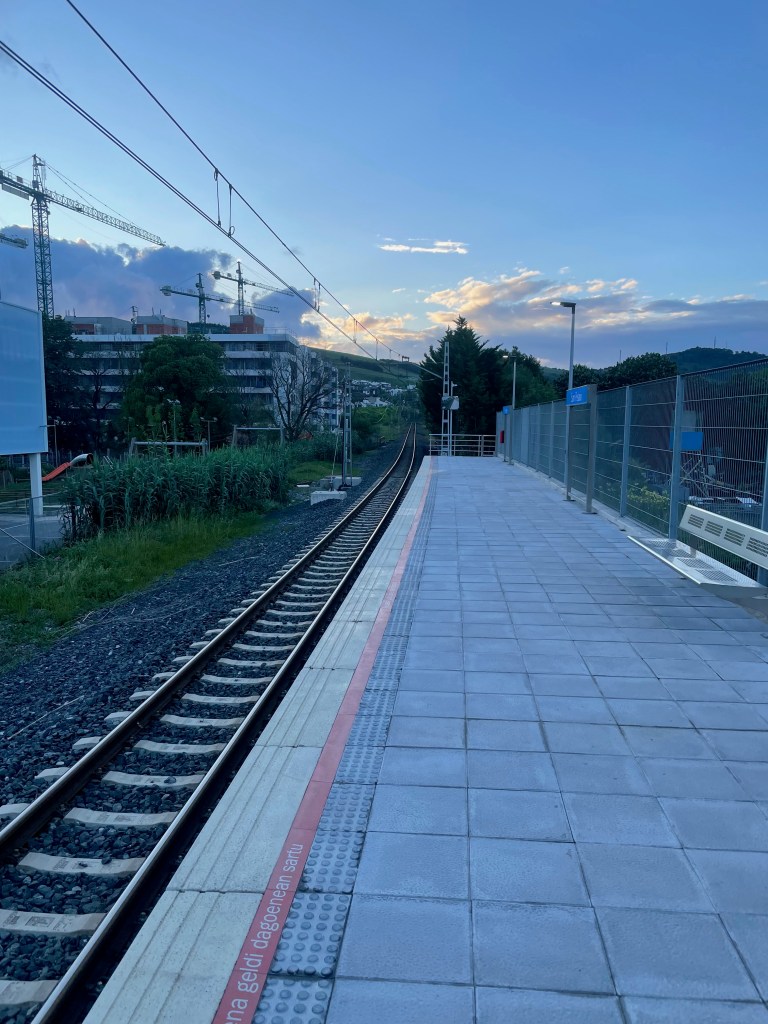
I wake up early. For once. By 6 a.m., I’m already up. I had seen that the rest of the Camino del Norte is 90% uphill, so I decide to change my plan and take a different route. I take the train back to San Sebastián – just a 22-minute ride for what had taken me almost five hours by bike.
I had planned to head to Pamplona, but since reading maps and making plans isn’t exactly my specialty, I end up buying tickets to Burgos, my starting point on the Camino Francés. The train leaves at 11, but it’s only 8, so I go for breakfast at the same café next to the hostel where I ate the day before.
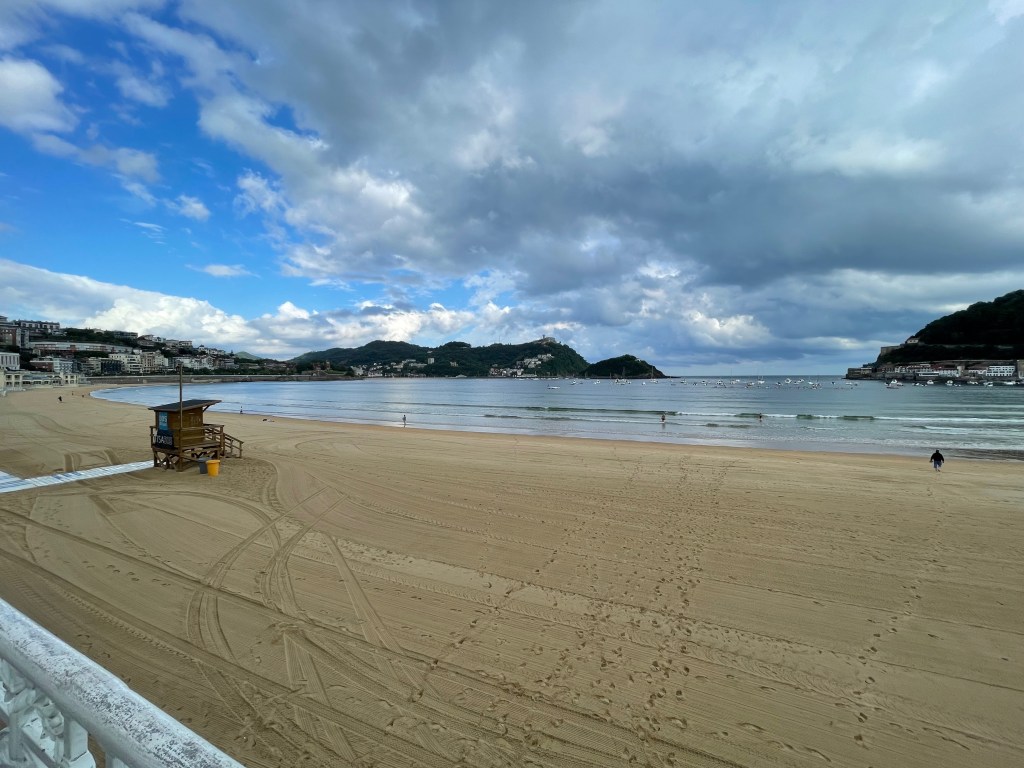
Since I have time, I take a walk along the coast – something I didn’t do yesterday. I spend a while appreciating the scenery, saying goodbye to the sea, knowing I won’t see it again for some time. Now it’s time to head inland.
I watch people swimming, walking along the sand, or simply sitting and watching the waves. I think about how I’d like to spend more time by the sea and that maybe I could stay in a coastal city later in my trip. Just then, I feel a few raindrops. I look up, and the sky is gray. This time, I won’t get caught in the rain, so I take one last look at the sea and head for the train station.
After 4 hours, I arrive at the station in Burgos. It’s 2 p.m., so I decide to grab something to eat. I find a decent spot about 15 minutes away by bike. As I ride, I notice the city is quite empty – I figure everyone is taking a siesta at this hour.
When I get to the restaurant, they tell me the kitchen is already closed and I can only order what’s at the counter. I have some bread with anchovies and keep riding. I’m still in the city, but the route feels much more bike-friendly. The terrain is relatively flat.
Eventually, I reach the point where the city ends and a gravel path lined with flowers begins. Yellow arrows on blue signs point the way, and I see pilgrims walking with backpacks. For the first time, I feel like I’m really on the Camino de Santiago. I’m alone, but I feel accompanied. Without realizing it, I’m starting a stage of the Camino that many pilgrims prefer to avoid – La Meseta.
Further along, I see a man by the side of the path fixing something on his bike. I ask if he needs help, and he thanks me but says no. I continue and later stop to grab a snack from my backpack. At that moment, the man I had seen earlier arrives and stops to ask if I need help. I say no, and we start chatting.
He tells me he’s from Cantabria and is also cycling the route. He asks where I’m heading today, and I tell him I plan to go about 50 km further. He says he’s only doing 20 km today. Then he pulls a map out of his backpack and shows me the route he plans to take. We decide to continue the journey together.
We pass through wheat fields, paths, and villages straight out of a painting. Somehow, they make me forget my fatigue and give me the energy to keep going. Eventually, we reach a summit with a sign marking the descent as “Mata Mulos” – the Mule Killer. It’s fitting – the downhill is steep.
After a while, we arrive at a small village called Hornillos del Camino. We settle into a hidden but cozy hostel and head out for dinner. Jose Carlos Argos, the Spaniard, shows me his map again and mentions that there’s a more bike-friendly route for tomorrow’s stage. We decide to continue together the next day and head to rest.
 motionserg