
I wake up early because I suspect there are bedbugs, and I can’t sleep peacefully. It’s five in the morning, and I decide to get up since I have to leave anyway. I confirm my suspicion when I see a fat bedbug next to my bed. I squash it, and it’s full of blood. I pack everything as quickly as I can and head to the kitchen to finish packing.
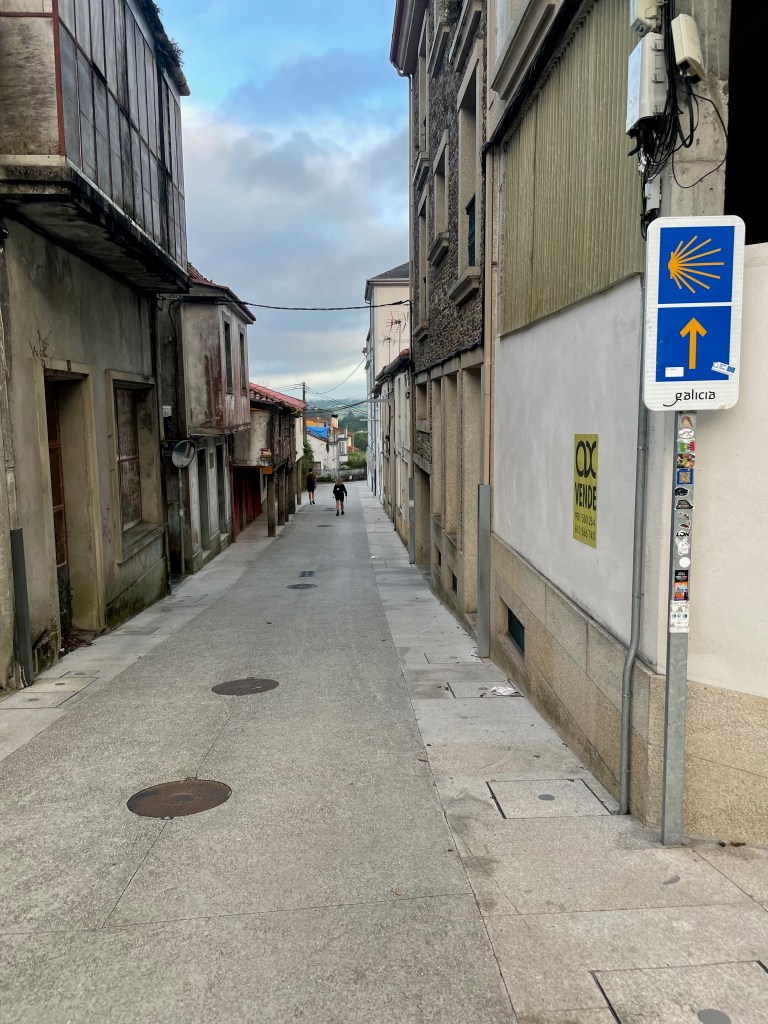
I’m the first to leave the hostel. As usual, I look for a nearby café to have breakfast before starting the day. I begin at a slow pace, as always. The path is clear, so I make good progress without seeing many people, which is unusual at this stage of the Camino.
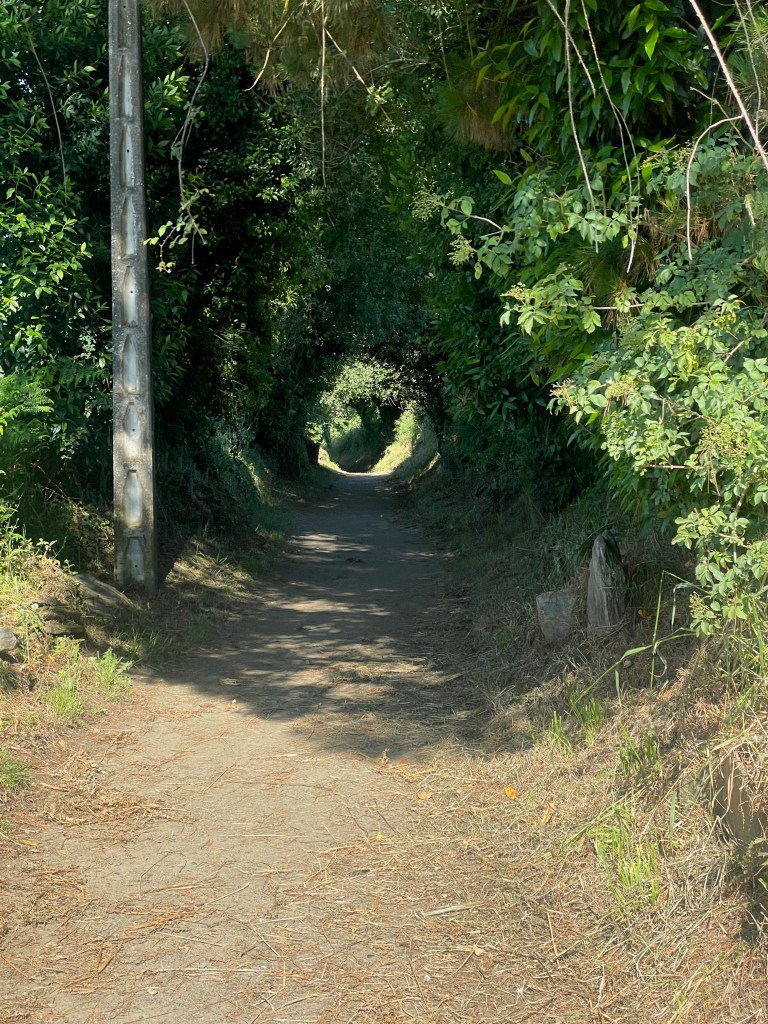
I walk along a rural, wooded trail through oak and eucalyptus groves when some cyclists pass me. Later, Friederike, an 80-year-old French woman from Lora’s group, also overtakes me. I recognize her from the description Lora gave me of her friend. I catch up to greet her, briefly interrupting her pace to take a photo together and send it to Lora. Then she moves ahead again, and I lose sight of her.
I’m halfway along the path when I decide to stop and eat something. My feet and knees ache, but they’re used to it by now. After getting up, it’s hard to get back into the rhythm. My knees feel heavy, but I keep going, slow and steady. I stretch a little and pick up the pace.
The sun is extremely strong—of course, on the day I decided to wear shorts. I stop to put on sunscreen, but it’s already too late because my calves are burning. At that moment, a woman catches up to me and, with a concerned tone, tells me my legs are very red.
We continue walking together, and she tells me she’s from Germany, so we start speaking in her language. The conversation touches on family and politics. At one point, as we cross the road, a bus approaches, and she says seriously:
—Careful.
After a few kilometers, we stop at a restaurant because she wants to eat something, and she offers to treat me. I order a Spanish omelet and a beer. She tells me she’ll finish her stage in this town today. I walk her to her hostel, which is just a few meters away, and as we say goodbye, she gives me some burn cream.
The day grows hotter and hotter. I see a milestone marking the last 45 kilometers to Santiago. Every step feels intense in the urban sneakers I’m wearing. I meet the Spanish women, who tell me they saw the Canadians a while ago and that they were in a hurry. I’m glad to hear it, as I thought I might not see them again.
I pass through a tree-covered section before reaching a misleading fork in the road. The yellow arrows mark the Camino, but I feel like I should already be close to the end of the stage. I check the map on my phone and realize I need to take an alternate, somewhat hidden path to enter O Pedrouzo, the destination for the day.
I arrive at the hotel I have reserved; unlike other days, this time I have a private room. I drop off my things and head to the laundromat a few blocks away. My feet throb with pain, even more so now that I’m wearing flip-flops, but they need to breathe. I walk at an extremely slow pace. I put all my clothes and my backpack in the dryer to eliminate any trace of bedbugs I might have brought with me.
It’s late, so I have limited lunch options. The restaurants won’t open for another hour, so I decide to go to a nearby supermarket to grab a snack in the meantime. The sun is still intense in the sky, and O Pedrouzo isn’t exactly a town with many trees.
Every step burns. Not just from the pain, but also from the heat of the asphalt. The trip to the supermarket feels endless. I finally arrive, and as I walk in, I’m greeted by a glorious blast of air conditioning. I’ve never appreciated the microclimate of a corporation so much.
I wander the aisles over and over, looking at every product and analyzing my options. I see a protein pudding, but I’d have to go back to the hotel to eat it since I don’t have a spoon. I also see some ready-to-eat meals that would need heating, which means returning to the hotel. At this point, going back to the hotel isn’t something I want to do.
After carefully inspecting all possibilities, I end up choosing a banana. I head to the checkout to pay, and they tell me they don’t accept cards. I used up all my cash at the laundromat, so I have no choice but to leave empty-handed.
I step outside, and the heat hits me again. I realize I spent so much time wandering the supermarket that the restaurants are about to open. I head to one and walk up to the counter to ask if their kitchen is open. Out of nowhere, a few elderly women sitting nearby say to me in a critical tone:
—You look exhausted.
I tell them I’ve just walked 500 kilometers, and they reply that they’ve walked more and feel fine. I don’t remember asking them, so I ignore them and go find a table. As I look around, I see the Korean man I yelled at in my sleep a few days ago. I approach and ask if I can sit with him. He agrees.
We order some food, and they serve a tiny portion with a small plate of fries to share. He barely speaks English, so we communicate through a translator and gestures. He asks me about Bolivia. He tells me he lives in Seoul and works as a mailman. I apologize for yelling at him that night. I’m not sure if he understood me, but I feel like he doesn’t care. We chat, laugh for a bit, and say goodbye.
I return to the hotel to drop off my clothes and start planning how to get back to Barcelona after reaching Santiago. There are only two days left, and I have few options. Direct flights, which used to cost 50 euros, now cost 650—more than an intercontinental trip. After analyzing several options, I decide to travel to Porto, spend a night there, and take a direct flight to Barcelona the next day.
I get a message from Lora saying she’s at a nearby bar, so I go to meet her. I find her sitting with the friends she’s told me so much about. She introduces me, and the conversation flows. I try a couple of Spanish beers, and later, the rest of the group leaves, and we’re left alone. We’re both exhausted from the heat wave.
I tell her we should go, and as we cross the road, a bus approaches. Lora says in a casual, almost teasing tone:
—But don’t get hit by the bus, duh.
I stop, and she repeats:
—You’ve come too far; this is no time to get run over by a bus.


 motionserg